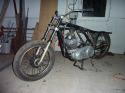
Es soll am Zylinderkopf im, am, beim, über - , unter-, neben- dem rechten Auspuffventilgehäuse ein Typ eingegossen (gestanzt, geschlagen) sein. Ich habe den Zylinderkopf meiner Norton angeschaut, betrachtet, verifiziert; was immer Du willst, nur demontiert habe ich ihn desswegen noch nicht. Wo verdammt ist denn diese Markierung?
Fritz
Das habe ich in meinen Unterlagen gefunden, wobei, wie schon von Joe erwähnt, die Bezeichnung, wenn sie denn da ist, immer rechts oberhalb des Ventildeckels eingeschlagen ist.
Gruß,
Andi
Norton Heavy Twins Heads
David Comeau-Aug 2000-updated Apr 2008
The pictured heads try to show the evolution and the details of Norton heavy twins from 1950 through 1975.
There are bound to be several 500, 600 and 650 heads that I have not gotten access to examine yet, and take pix of.
They will be provided if the opportunity arises.
THREADED HOLES-All the threaded holes on all aluminum heavy twin heads are whitworth form. There are 4 different threads.
1. 3/8 BSF
Atlas & Commando-on the 3 head/barrel studs.
Atlas-head steady center stud
2. 5/16 BSF
Atlas & Commando- intake rocker cover stud
Atlas- 2 oil inlet on top of head
Commando-2 oil holes on side of head + 3 headsteady bolts.
3. 5/16 BSW
Atlas and Commando-intake port/manifold
4. 1/4 BSW
Atlas & Commando- rocker spindle cover plate screws (pre 66-short)
Atlas & Commando- exhaust rocker cover studs
Exhaust ports are 1-15/16x14tpi, The factory shop manual tech specs seem to be in error.
Click on pictures for full size view
*This first series of Norton Heavy Twin head have a small bolt pattern spacing for 500, 600,& 650 and will not interchange on to later 750 spacing or 850 spacing.The C-C head stud spacing, for the holes forward from the spark plugs, is 6-7/8".
*All the following heads are top oil feed until the commando series.
The first Norton head had an integral manifold for a short period of production. No pix available yet.
Then this cast iron head, T2140 (1950), was the second Norton Heavy Twin head, and had a separate aluminum manifold. The T2140 marking is above the intake rocker box cover. A second head, marked T2212, seems to be identical to T2140. T2212 was on newer model 7's. Small intake valves on this 500 cc engine/head. It uses 1/2" reach plugs. The exhaust ports are each splayed only 20º from straight forward, only half the angle of the later heads. Unlike aluminum heads, the headsteady center stud is tapped for 3/8-26tpi in the head. It is quite massive with the iron material at a bit over 26 lb., more than double it's aluminum counterpart below. It would have contributed to a smoother ride due to it's added vibration dampening of the tiny 500 cc engine. It is held onto the barrels by 3/8-26cei bolts. Notice the horizontal AND vertical finning in front of the spark plug. The vertical spacing for the intake manifold studs on these early heads is 1.50".
Norton p/n D12/136 ?
This third head is from a model 88 (500cc) version that started about 1955. This aluminum casting is also marked with # T2225 M above the intake rocker cover. It is cosmetically/visually the same as the previous iron head. It is also held on with 3/8" bolts. The center head steady stud is now 3/8BSF. Small intake valves and 3/4 reach plugs. It is much lighter than the head above at about 13 lbs. Again, both horizontal and vertical finning in front of the spark plug. The vertical manifold stud spacing is still 1.5" on this version of NHT head. The C-C head stud spacing for the holes forward from the spark plugs is 6-7/8".
Norton p/n K12/136 ?
This norton head is a late model standard 88 head (not 88SS) in it's final version through 1963, the last year of production.It has a casting number of 22707 K, which is again located above the intake rocker box cover. It has slightly increased finning all over but especially in the exhaust area. The finning pattern in front of the spark plug is all horizontal now. The spacing of the intake manifold studs has increased to 1.625".
Norton p/n R12-2/136 ?
Following is a down draught head from a 650SS, 88SS. It has the casting number22707 W on top of the head. It additionally has the casting number of 23166 on the bottom of the head. The 23166 casting is used later on in the early atlas, but the 650SS head still uses the small head bolt pattern spacing. The 72mm barrel spigot relief is the edge of the combustion chamber.It still uses the early small valves. It has 28.5mm ports, which makes it a quite potent head for these small size engines.
Norton p/n S650/136
*A few excerpts from Jim Bush on a late 650 mercury head.
I have a letter from NOC President John Hudson to the previous owner from back in 1993. John stated that "the 06-0380 casting was the Commando head and would not fit". Well I obviously have an exception as the 06-0380 head I have is definitely machined for the 650 - dome size, bolt pattern and top oil feed. The side casting ribs are almost all gone (machined) as per any Commando. It has not been modified at all,
original casting all round, no welding. I surmise that this head is a late 650 (Mercury) or a early 1970's replacement item, part of a small batch produced for ongoing stock/warranty work.
All 650's and 750's Dominator have top oil feed, and share same casting 25319# (with small exception 06-0380 noted above) All Commando's have side oil feed - casting #06-0380 The only reason I see they switch to side oil feed is the isolastic head steady mounting studs go where the top oil feed hole goes. Casting changes were not required to put oil feed on top or on the side.
These are the 650 Mercury head pix supplied by and with my thanks to Jim Bush.
*All the following Norton Heavy Twinheads are of the 750 bolt pattern spacing group. The C-C head stud spacing for the holes forward from the spark plugs is 7-1/8" for all 750 heads.
The BIRCO symbol and 23166 are both easily identified by the positives in the casting of this early ATLAS head. These heads have the late style re-angled exhaust ports at 80º included angle or 40º each from straight forward. It has carried over 28.5mm intake ports from the previous heads. The head bolts have been unfortunately down sized to 5/16-26cei.The spigot relief machining is 75mm.Oiling is top feed.
The same head with the 25494 steel conversion ring installed. This allows the use of this head on unspigotted flat topped barrels.
See the pronounced fin pattern between the rockers. The rocker oil feed is different from the commando in that the oil comes in from the top of the head, the boss right above and between the rocker shafts.
This is the late atlas head 25319. It has the same combustion chamber and squish band as the 750 commando (no spigot).
They have 28.5mm ports. It is the core for my 68 Dunstall Atlas with a very nice porting job.
*COMMANDO - The C-C head stud spacing, for the holes forward from the spark plugs, continues at 7-1/8" for all 750 heads.
*Oiling is now side feed
*The head bolts have wisely been upsized back to 3/8-26cei.
*I will also to try and clear up the misinterpreted information that then gets quoted as credible information.
Simply put....The letter from the factory below, clearly states this head, identified as RH1 (though not marked as such), as being for 30mm CARBS and does not refer to the port size.
Below is the early 68-70 commando head casting number 06-0380. .These standard RH1 ports are 28.5mm or 1.12". The number and BIRCO are easily visible on the intake side as positives.
The space between the front top 1st and 2nd fins are full of aluminum. There is still some finning pattern on the side of the head between the rockers.
The 71/72 head. This would be the 2nd series of commando head,. as a standard 71and 72 small port they have original port size of 28.5mm. In 72 the head would be marked with a "C" in the center top of the head to indicate the combat conversion was done. The combat RH3 was cut .042" to raise the compression. It had a 32 mm porting job. It appears the factory learned more about the porting business as time went on. First hand inspection of several "combat" porting jobs show how crudely (bad) they were done. Big.... yes. By today's standards these heads have been ruined. The "BIRCO" on the right and the casting number faintly visible on the left side are negatives (depressions in the surface).
A 71 head with a "rotated away from exhaust" big intake valve Dunstall conversion. It has 32 mm intake ports. The squish band being completely machined away. It was for use with a Dunstall 810 barrel kit and the R3 cam which was very similar to the norton combat cam. I suspect this combination was the claimed 75 hp engine.
This side shot shows the "finning" pattern is now almost all gone. The space between 1st and 2nd fins has come back.
This is a RH5 73 low compression 32 mm port head. NO birco or part number of any kind is remotely visible. The side profile is indistinguishable from the 71/72 head. The RH6 32 mm port head would be the semi high compression with .020 cut off the head. The 73 factory parts manual shows a RH1 available. Labeled as 30 mm for the carbs they will use, it is the same as early RH1 with 28.5mm ports. Some 750 heads received 850 sized guides and were marked with an S, however they seem to be fairly rare.
*The following 850 Norton Heavy Twinheads have an even wider bolt pattern than both the earlier 750 head bolt pattern or the 500-600-650 series. The C-C head stud spacing, for the holes forward from the spark plugs, has grown to 7-1/4" for all 850 heads..
A 73&75 RH4 850 32 mm port head. The porting job out to 32 mm seems to have improved somewhat over the combat. The 850 head types are marked above the right hand exhaust rocker cover. They show a much bigger head gasket pattern compared to all the earlier head styles.
From the side, visually almost identical from the 71-73 750 head. The head bolts are farther out by about 1/8" but sometimes hard to tell unless the two heads are side by side. The RH4/RH10 marking above the right hand exhaust rocker cover is the give away! . Many of these heads have 063807 casting # as a negative on the front bottom.
It has recently become apparent that the thin intake port wall under the spring perch results in a very high percentage of RH4 heads being cracked at one or both guides. A simple dye penatrant test reveals this unfortunate reality, which evades detection by a casual glance into the port. So far, the RH10 heads seem to be much less crack prone. In my opinion, the 30 mm 74/850 RH10 head is a rarer but much more desirable core for doing good porting work
Mike Wilson Memorial head RH4 porting. Bashed to smithereens when a valve head broke off and went on a rampage. The head combustion chamber has been completely welded up. A 1-5/8" radius combustion chamber will be machined back in. It will get the 42 mm rotated intake valve Dunstall treatment. The squish band will not be machined back in an attempt to keep the compression up there. . A Lotus Elan combustion chamber is the basic effect desired.
The following letter is supposed to have been from the factory.
Sorry... I forgot who sent it to me, but thank you whoever it was.
factory head designation letter 120k.jpg
Signor Rossi hat geschrieben:Das habe ich in meinen Unterlagen gefunden, wobei, wie schon von Joe erwähnt, die Bezeichnung, wenn sie denn da ist, immer rechts oberhalb des Ventildeckels eingeschlagen ist.
Gruß,
Andi
Norton Heavy Twins Heads
David Comeau-Aug 2000-updated Apr 2008
*A few excerpts from Jim Bush on a late 650 mercury head.
I have a letter from NOC President John Hudson to the previous owner from back in 1993. John stated that "the 06-0380 casting was the Commando head and would not fit". Well I obviously have an exception as the 06-0380 head I have is definitely machined for the 650 - dome size, bolt pattern and top oil feed. The side casting ribs are almost all gone (machined) as per any Commando. It has not been modified at all,
original casting all round, no welding. I surmise that this head is a late 650 (Mercury) or a early 1970's replacement item, part of a small batch produced for ongoing stock/warranty work.
All 650's and 750's Dominator have top oil feed, and share same casting 25319# (with small exception 06-0380 noted above) All Commando's have side oil feed - casting #06-0380 The only reason I see they switch to side oil feed is the isolastic head steady mounting studs go where the top oil feed hole goes. Casting changes were not required to put oil feed on top or on the side. .....
Der Teil ist denifiv flasch. Heinz Kegler hatte eine Zeichnung eines 650er-Kopfes, bei der mit Datierung vom 04-06-1965 schon "Use casting 06-0380" drauf stand. Soviel zum Thema, der NOC wüsste, wovon er spricht .....
Tim
1946 Indian Chief-1956 Norton Dommie-1970 Norton Commando Roadster-1972 HD FLH1200 Electra Glide-1972 Norton Commando
1968 Lotus Elan+2-1997 Lotus Elise S160-1999 Lotus Elise
Parts falling of these vehicles are of the finest Angloamerican craftsmanship!
Atlas750 hat geschrieben:
Der Teil ist denifiv flasch. Heinz Kegler hatte eine Zeichnung eines 650er-Kopfes, bei der mit Datierung vom 04-06-1965 schon "Use casting 06-0380" drauf stand. Soviel zum Thema, der NOC wüsste, wovon er spricht .....
Tim
Vielleicht hab ich Dich falsch verstanden aber so unrichtig scheinen mir diese Aussagen nicht:
merc.jpg
mercs.jpg
Das sind die Bilder von denen gesprochen wird.
«These are the 650 Mercury head pix supplied by and with my thanks to Jim Bush.»
Sie sind Eigentum von Jim Bush. Ich habe sie von dieser Website kopiert: http://atlanticgreen.com/nhth.htm und meines Wissens ist diese Site nicht mit dem NOC asoziiert.
Fritz
Du hast keine ausreichende Berechtigung, um die Dateianhänge dieses Beitrags anzusehen.
bad_friday hat geschrieben:Vielleicht hab ich Dich falsch verstanden aber so unrichtig scheinen mir diese Aussagen nicht: ....
Also, was ich meinte, sind die Aussagen von John Hudson - ehemaliger NOC-Presi - die sind flasch, es gibt sogar eine Werxzeichnung zwei Jahre vor der Commando mit explizit dieser Gussteilnummer. Die zitierte Vermutung (!) von Jim, dass das Ersatzteile aus der Phase sind, in der die Mercury und die Commando parallel gebaut wurden, sind demnach auch flasch, aber Jim nennt das ja auch explizit eine Vermutung.
Ich war tatsächlich mal zwei Jahre NOC-Mitglied, hab das dann aber auslaufen lassen, weil der Hauptgrund war, dass ich mit Hilfe bei der Datierung von zweien meiner damals gekauften drei Rotten Commandos erhoffte. Diese Hilfe fiel spärlich aus bzw. war selbst mit meinem minimalen Wissen über Commando-Nummern damals schon als fragwürdige Auskunft zu erkennen. Dazu kamen noch zwei, drei "technische" Artikel in der Roadholder, die derart bekloppt waren - Stoßdämpfer anbohren, Öl nachfüllen, Loch mit Gummi-Stopfen verschließen und dann den Stopfen mit einer Schlauchschelle "sichern und solche Scherze - dass ich mich intellektuell beleidigt gefühlt habe. Joes Spezialfreundin aus dem NOC-Forum ist mir auch - bevor ich ihn da überhaupt hab posten sehen - derart mies aufgefallen, dass ich mich da auch lieber nicht rumtreiben wollen würde. Nö, der NOC hat IMHO keine Relevanz in der Norton-Welt derzeit. Mag durchaus sein, dass das mal anders war, aber alles was ich aus der Ecke mitbekomme, genieße ich mit äußerster Vorsicht.
Tim
1946 Indian Chief-1956 Norton Dommie-1970 Norton Commando Roadster-1972 HD FLH1200 Electra Glide-1972 Norton Commando
1968 Lotus Elan+2-1997 Lotus Elise S160-1999 Lotus Elise
Parts falling of these vehicles are of the finest Angloamerican craftsmanship!
Andover Norton hat seine Anzeigen im NOC "Rottholder" schon vor Monaten storniert. Hat uns überhaupt nicht geschadet, nach unserem stetigen Umsatzzuwachs zu urteilen. Abgesehen von dem Hauptgrund, warum ich die Anzeige gestopt habe, und der bis heute nicht behoben ist, glaube ich inzwischen auch, daß der NOC sich an die Ewiggestrigen wendet. Ich hatte erst kürzlich wieder ein Gespräch mit dem Anzeigenwerber des NOC und habe ihm gesagt, daß unsere Entscheidung steht.
Leute, die Löcher in Stoßdämpfer bohren, Öl einfüllen, und das ganze mit der Schlauchschelle verschließen, nenn ich Leichenwiederbeleber. Diese Deppen sollen weiter ihre Taiwan- und Indien-Replicateile, nicht zu vergessen ihre Schlauchschellen zum Stoßdämpferwiederbeleben, vom verwirrten NOC Spares Officer kaufen. Die seh ich nicht als Andover Nortons Kundenzielgruppe.
So weich waren wir noch nicht mal in unserer Studentenzeit in den 1970ern, wo das Essen zugunsten des Geldes fürs Tanken eingespart wurde!